


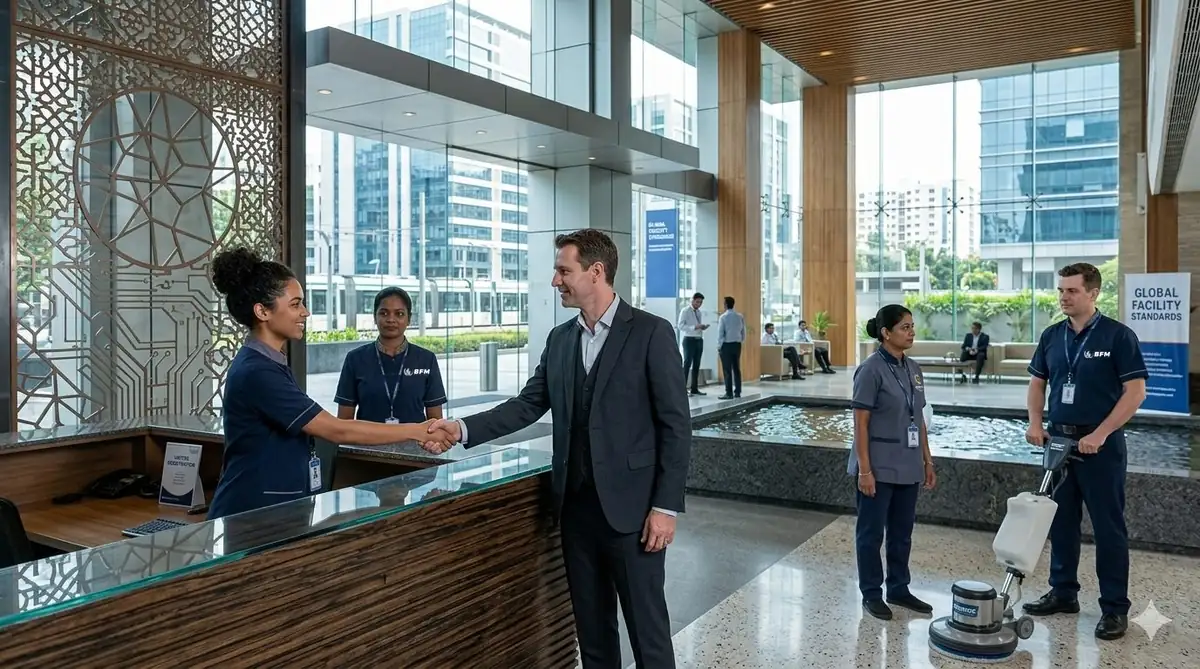
Thirty years in the same city
BFM started in Mazgaon in 1994 and never moved. That matters more than it sounds: our supervisors live on the same local lines as the staff they manage, so a 6 a.m. shift change in Churchgate or a callout in Goregaon is a twenty-minute problem, not a next-day one. Most of our Mumbai contracts have run for over five years.
What Mumbai buildings actually need
Mumbai splits into two different jobs. In the island city — Churchgate, Lower Parel, Mazgaon, BKC — you are usually working around a live office floor, in older service cores, with lifts that cannot be taken out of use during business hours. In the western and central suburbs the buildings are newer and taller, and the work shifts towards podium levels, STP plants, basement parking and clubhouse upkeep.
We staff those two differently. Island-city sites get smaller teams working tighter windows, usually early morning and after 7 p.m. Suburban towers get a larger day presence because there is simply more built area per building to cover.
The monsoon is the real test
Between June and September a Mumbai contract is judged on three things: whether the lobby stays dry and safe underfoot, whether the drains and pumps were cleared before the first heavy spell, and whether anyone answers the phone at 11 p.m. when water is coming in. We pre-monsoon every site — terrace outlets, podium drains, sump pumps, DB moisture checks — and we publish that checklist to the client before the rains, not after.
Government and private, under the same standard
We run GST office floors at Churchgate, Lower Parel and BKC alongside private developer sites for JP Infra, Sunteck and Smaaash. Government sites bring documentation, attendance discipline and statutory compliance to a level most private contracts never ask for — and we apply the same paperwork to every client, because it is easier to run one standard than two.